Harness Engineering: The Discipline That Makes AI Agents Actually Work
If 2025 was the year of the AI agent, 2026 is the year of the harness.
The industry has learned a hard lesson: building an agent is the easy part. Making it reliable, cost-predictable, and safe in production is where the real engineering happens. According to IDC research, 88% of AI proof-of-concept projects historically fail to reach production — though more recent data shows improvement, with 46% of AI POCs now advancing to deployment. The bottleneck is not the model. It is the absence of a production-grade harness.
This post explores harness engineering — the hottest emerging discipline in AI engineering — what it is, why it matters, how it works, and how to start implementing it today.
What Is Harness Engineering?
The term was popularized by Mitchell Hashimoto (co-founder of HashiCorp and creator of Terraform) in February 2026. He described a habit of engineering permanent fixes into the agent’s environment every time it made a mistake — he called it “engineering the harness.” Within weeks, OpenAI published their take, and Birgitta Bockeler published a detailed analysis on martinfowler.com exploring the concept in depth. The term had arrived.
The core equation:
Agent = Model + Harness
The harness is everything in an AI agent except the model itself — the instructions, context, tools, runtime, permissions, constraints, feedback loops, and verification systems that wrap around the model to make it work reliably.
The analogy comes from horse tack — reins, saddle, bit — the complete set of equipment for channeling a powerful but unpredictable animal in the right direction. A useful technical analogy: the model is the CPU, the context window is RAM, the harness is the operating system, and the agent is the application. You wouldn’t run software directly on a CPU without an OS — similarly, you wouldn’t deploy an AI agent without a harness.
The Three Layers of AI Agent Development
Harness engineering didn’t emerge in isolation. It builds on two prior disciplines:
| Layer | What It Optimizes | Scope |
|---|---|---|
| Prompt Engineering | What you say to the model | Single turn quality |
| Context Engineering | What the model sees | Multi-turn information flow |
| Harness Engineering | The execution environment | Hours of unsupervised operation |
These aren’t competing approaches — they’re a progression. Prompt engineering shapes a single request. Context engineering manages what the model knows across interactions. Harness engineering designs the entire system that lets an agent operate autonomously for extended periods.
Why the Harness Matters More Than the Model
The most compelling evidence: LangChain improved their coding agent from 52.8% to 66.5% on Terminal Bench 2.0 — a massive ranking jump — by changing nothing about the model. They only changed the harness. Same model. Different harness. Dramatically better results.
Their modifications were purely harness-level: self-verification loops, better context engineering, loop detection, and reasoning optimization.
This validates the central thesis of harness engineering: the moat is the harness, not the model. OpenAI even shipped a Codex plugin inside Claude Code — a competitor’s tool — underscoring that model interoperability is increasingly the norm, while harness design becomes the key differentiator.
Core Architecture: Guides and Sensors
Birgitta Bockeler’s detailed article on harness engineering (published on martinfowler.com) introduces a cybernetic framework built on two control mechanisms:
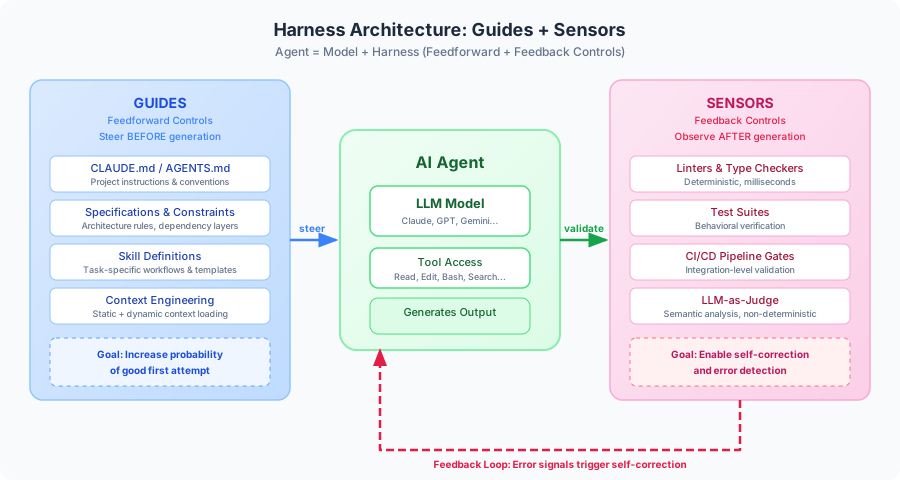
Guides (Feedforward Controls)
Guides steer agent behavior before generation occurs, increasing the probability of good first-attempt results. Examples:
CLAUDE.md/AGENTS.mdfiles — project-level instructions that load into the agent’s context- Specification documents — structured requirements that define what “correct” looks like
- Architecture constraints — dependency layering rules (e.g.,
Types → Config → Repo → Service → Runtime → UI) - Skill definitions — narrow, on-demand workflows for specific task types
Sensors (Feedback Controls)
Sensors observe after the agent acts and enable self-correction. Examples:
- Linters and type checkers — fast, deterministic validation (milliseconds)
- Test suites — behavioral verification against specifications
- CI/CD pipelines — integration-level validation gates
- LLM-as-judge — semantic analysis for issues that deterministic tools can’t catch
The Critical Insight
Feedforward alone creates agents that encode rules without validation — they follow instructions but can’t detect when they’ve gone wrong. Feedback alone creates agents that repeat identical mistakes — they can detect failures but keep making the same errors. A production harness needs both, working together.
| Control Type | Speed | Reliability | Best For |
|---|---|---|---|
| Computational (tests, linters) | Milliseconds | High, deterministic | Structural issues, style, coverage |
| Inferential (LLM-as-judge) | Seconds | Non-deterministic | Semantic judgment, design quality |
Seven-Layer Harness Architecture
A production-grade harness has at least seven layers:
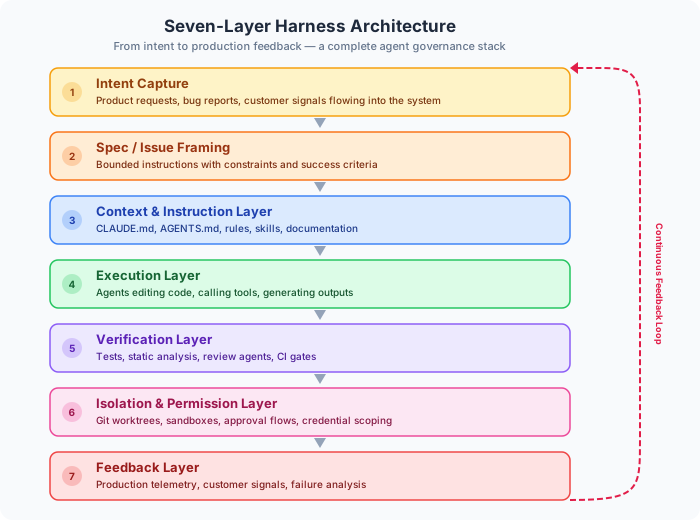
- Intent Capture — Product requests, bug reports, customer signals flowing into the system
- Spec/Issue Framing — Bounded instructions with constraints and success criteria
- Context & Instruction Layer — Repository guidance (
CLAUDE.md), rules, skills, documentation - Execution Layer — Agents editing code, calling tools, generating outputs
- Verification Layer — Tests, static analysis, review agents, CI gates
- Isolation & Permission Layer — Git worktrees, sandboxes, approval flows, credential scoping
- Feedback Layer — Production telemetry, customer signals, failure analysis feeding back into layers 1-3
This is a synthesis of patterns observed across production agent systems. OpenAI’s Codex team, Stripe’s agent infrastructure, and Anthropic’s multi-agent systems all implement elements of this layered approach, though each with their own specific architecture.
Real-World Case Studies
OpenAI Codex: 1 Million Lines, Zero Human-Written
A team that started with three people (later growing to seven) began with an empty repository in August 2025. For five months, they wrote no code themselves — every line was generated by Codex. The result: 1 million lines of production code and 1,500 merged pull requests.
Crucially, it did not work well at the start. Early productivity was low due to missing environment setup, weak tool integration, and poor recovery logic. Performance rose sharply only as the harness was improved step by step.
Their key harness decisions:
- Layered architecture enforced via custom linters and structural tests
AGENTS.mdkept lean (~100 lines) as a map pointing to a structureddocs/directory- Recurring “garbage collection” agents scanning for architectural drift with auto-suggested fixes
- Pre-push hooks triggering relevant validation before code leaves the developer’s machine
Microsoft Azure SRE Agent: 35,000+ Incidents
Microsoft’s Azure SRE Agent has handled 35,000+ production incidents autonomously, reducing Azure App Service time-to-mitigation from 40.5 hours to 3 minutes. The harness integrates MCP tools, telemetry, code repositories, and incident management platforms into a unified system with human-in-the-loop governance.
This is one of the most data-backed production harness case studies published to date.
Anthropic’s Multi-Agent Harness
Anthropic described a harness where a Planner expands a short prompt into a full product spec, a Generator implements features in sprints with a “sprint contract,” and an Evaluator tests the application using Playwright like a real user.
A solo agent produced a broken game. The three-agent harness produced a working game with an AI-assisted sprite generator and level designer. Same model. Different harness. Dramatically different outcome — the pattern keeps repeating.
The Harness Engineer Role
A new role is crystallizing around these practices:
| Role | Focus | Key Question |
|---|---|---|
| Software Engineer | HOW to implement | ”How do I write this code?” |
| Product Manager | WHAT to build | ”What should we build?” |
| DevOps Engineer | WHERE to deploy | ”How do we ship this?” |
| Harness Engineer | HOW agents operate safely | ”How do I design an environment where an agent can do this correctly?” |
Five Core Skills
-
Context Engineering — Architecting information flow: what the agent sees, when, and how much. Loading, pruning, and persistence strategies.
-
Constraint Design — Establishing behavioral boundaries: what the agent can do autonomously, what requires approval, and what is forbidden.
-
Tool Orchestration — Providing controlled access to appropriate tools via structured interfaces — not unrestricted access to everything.
-
Specification Governance — Maintaining active contracts between humans and agents, organized hierarchically: constitution → spec → plan → tasks.
-
Quality Loop Design — Embedding verification throughout the generation process: static analysis, type checking, linting, security scanning, testing.
Claude Code: A Harness Engineering Case Study
If you’re using Claude Code, you’re already interacting with one of the most sophisticated harness implementations in production. Consider what it does:
CLAUDE.mdfiles — Hierarchical context injection (global → project → directory level)- Tool orchestration — Structured access to Read, Edit, Write, Bash, Grep, Glob with clear permission boundaries
- Permission system — Graduated autonomy tiers (auto-allowed vs. requires approval)
- Memory persistence — Cross-session knowledge retention via the auto memory directory
- Feedback loops — Build failures feed back into the agent’s context for self-correction
- Isolation — Git worktrees for parallel work without conflicts
The model is powerful, but the harness is what makes it reliable. The same Claude model without this harness would be dramatically less useful for real development work.
Practical Implementation: Where to Start
Based on the Escape.tech field report from SF and industry best practices:
First 30 Days
- Run agents on real work for two weeks — Log every revert, rework, and rejection. Don’t standardize on day one.
- Build guardrails around observed failures — Not hypothetical risks, but actual failure modes you’ve seen.
- Require CI and automated review on all agent-generated PRs.
- Rewrite issue templates to emphasize intent and success criteria, not implementation steps.
Graduated Autonomy Tiers
Not all tasks need the same level of human oversight:
| Tier | Task Type | Review Level |
|---|---|---|
| Full autonomy | Typo fixes, test additions, dependency bumps | CI + automated review only |
| Light review | Feature work within established patterns | < 5 min human skim |
| Full review | New endpoints, data model changes | Thorough human review |
| Human-led | Migrations, infrastructure, security-critical paths | Human writes, agent assists |
Key Metrics to Track
- Lead time: Issue creation → merged PR
- Agent autonomy rate: % of tasks completed without human intervention
- Reopen/rollback rate: How often agent work needs to be undone
- Wasted work rate: Features reverted within 30 days
- Issue clarity: % of issues agents can act on without clarification
- Monthly API cost per engineer
The Verification Principle
One pattern emerges consistently across every successful harness implementation:
Verification beats advice.
When an agent keeps making the same mistake, the instinct is to add more instructions to the guide. But the more effective approach is to add a deterministic sensor — a linter rule, a test, a pre-commit hook — that catches the error automatically and provides repair instructions.
Instructions rot over time and crowd the context window. Deterministic verification is permanent and mechanical. Convert recurring error classes into rules, not documentation.
What’s Next
Harness engineering is still in its infancy. The term itself only entered mainstream use in early 2026. Several open problems remain:
- Harness coherence — How to maintain consistent guides and sensors as systems grow, avoiding contradictions
- Conflict resolution — What happens when instructions and feedback signals disagree?
- Coverage evaluation — How do you know if your harness is comprehensive enough? (analogous to code coverage, but for agent governance)
- Behavioral verification — The gap between “code that compiles and passes tests” and “code that solves the right problem” remains the field’s largest unsolved challenge
But the direction is clear. As models become more capable and more interchangeable, the harness becomes the primary engineering artifact. The developers who thrive won’t be the fastest coders — they’ll be the best harness engineers.
References:
- OpenAI — Harness Engineering
- Martin Fowler — Harness Engineering for Coding Agent Users
- Escape.tech — Everything I Learned About Harness Engineering in SF (April 2026)
- NxCode — Harness Engineering Complete Guide
- BSWEN — Harness Engineer: The New Role
- Milvus — What Is Harness Engineering for AI Agents