The AI Engineering Landscape in Spring 2026: What You Need to Know
April 2026 may be the densest month in AI history. Four frontier models dropped in a single window, agentic AI moved from demos to production deployments, and the infrastructure layer shifted beneath our feet. This post is my attempt to distill the noise into a structured knowledge base — what matters, what’s hype, and what we as AI engineers should actually learn.
1. The Frontier Model Landscape
The “Big Three” — Anthropic, OpenAI, and Google — are now in a genuine three-way race, with open-source contenders closing the gap fast.
Current Frontier Models (April 2026)
| Provider | Model | Highlights |
|---|---|---|
| Anthropic | Claude Opus 4.6 | Strong on HLE (53% with agentic tools), SWE-bench Verified (80.8%), 128K output tokens |
| OpenAI | GPT-5.4 (Standard / Thinking / Pro) | Unified general-purpose + coding line, native computer use |
| Gemini 3.1 Pro | SWE-bench Verified (78.8%), GPQA Diamond (94.3%), native multimodal reasoning | |
| Meta | Llama 4 Scout | 10M context window, MoE architecture, open-weight |
| DeepSeek | V4 | 1.6T parameters, competitive pricing, Ascend NPU inference support |
The key takeaway: no single model wins everything. Claude excels at writing and instruction following, GPT-5.4 at tool use and computer interaction, Gemini at multimodal reasoning and code, and open models like Llama 4 and DeepSeek V4 are closing the gap at a fraction of the cost.
Cost Collapse
API costs have dropped dramatically year-over-year, with open-source models like DeepSeek V3.2 offering competitive quality at a fraction of frontier model pricing. This has profound implications for architecture decisions — you can now afford to run multi-model pipelines where different models handle different subtasks.
Benchmarks Worth Watching
- Humanity’s Last Exam: The hardest general knowledge benchmark. Top models jumped from 8.8% (late 2024, o1 without tools) to over 50% with agentic tool setups, though without-tools scores remain in the 30-44% range.
- SWE-bench Verified: Real software engineering tasks. Claude Opus 4.6 leads at 80.8%, with Gemini 3.1 Pro close at 78.8%.
- ARC-AGI-2: Novel reasoning under constraints. Scores have improved significantly — Gemini 3.1 Pro reached 77.1% — but the benchmark continues to reveal gaps in abstract reasoning.
2. Agentic AI: From Chatbots to Autonomous Workers
2026’s defining theme is the shift from conversational AI to agentic AI. An agent doesn’t just answer questions — it breaks down complex goals, executes multi-step plans across systems, and adapts when things go wrong.
What Makes AI “Agentic”?
An agentic system combines four capabilities:
- Planning — Decomposing a high-level goal into executable steps
- Tool Use — Calling APIs, querying databases, reading files, executing code
- Reflection — Evaluating intermediate results and adjusting the plan
- Memory — Maintaining context across interactions and sessions
Production Reality Check
While NVIDIA’s GTC 2026 was dominated by agentic AI and Fortune 500 companies have announced production deployments, the picture is nuanced. MIT Sloan Review notes that AI agents “just aren’t generally ready for prime-time business” — experiments show too many mistakes for high-stakes processes. The honest engineering answer: agents work well in constrained domains with clear guardrails, but fully autonomous agents operating on critical business processes remain premature.
Where Agents Are Working Today
- Code generation and review — GitHub Copilot Workspace, Cursor, Claude Code
- Customer support — Structured workflows with human escalation
- Data analysis — Multi-step queries across heterogeneous data sources
- DevOps — Automated incident triage, log analysis, runbook execution
3. MCP vs Function Calling: The Infrastructure Layer
This topic is particularly relevant to my work, having built an LLM-powered IoT monitoring platform using function calling for tool orchestration. Understanding the difference between these two approaches is critical for any AI engineer in 2026.
Function Calling
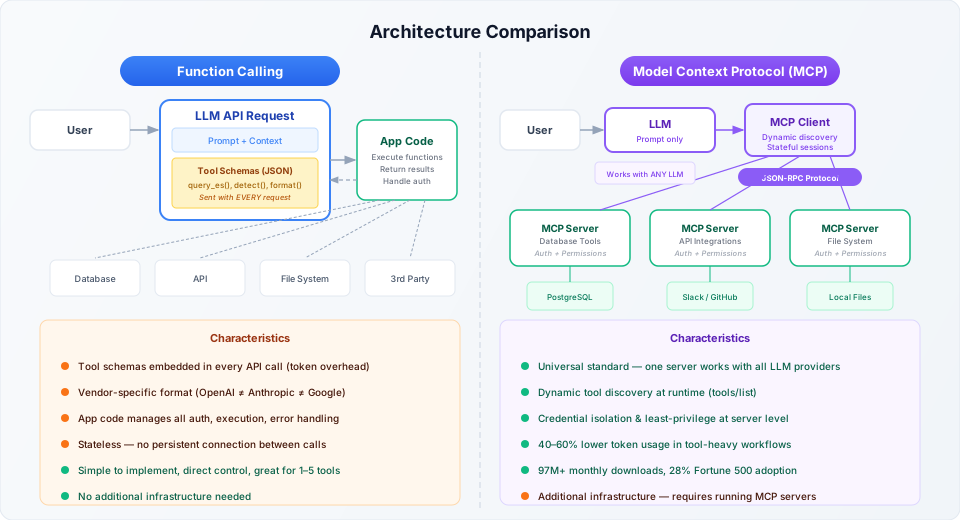
Function calling is the approach I used in production: you embed tool definitions (JSON schemas) directly in your LLM request. The model decides which function to call, your application executes it, and the result goes back to the model.
User Query → LLM (with tool schemas) → Function Call → Your Code Executes → Result → LLM → ResponseStrengths:
- Simple to implement and debug
- Direct control over execution
- Works with any LLM provider that supports it
- No additional infrastructure needed
Limitations:
- Tool definitions sent with every request (token overhead)
- Tight coupling between tool schemas and application code
- Vendor-specific implementations (OpenAI format ≠ Anthropic format)
- Scaling to 50+ tools becomes unwieldy
Model Context Protocol (MCP)
MCP, introduced by Anthropic in late 2024 and donated to the Linux Foundation in December 2025, takes a fundamentally different approach. Instead of embedding tools in each request, MCP servers expose capabilities through a standardized protocol that any MCP client can discover and use.
LLM ↔ MCP Client ↔ MCP Server (tools, resources, prompts) ↔ External SystemsKey advantages over function calling:
- Universal adapter: Build one MCP server, works with Claude, ChatGPT, Gemini, Cursor, etc.
- Dynamic discovery: Tools are discovered at runtime via
tools/list, not hardcoded - Stateful sessions: Persistent connections reduce overhead
- Credential isolation: Authentication handled at the server level, not in prompts
- Lower token overhead in tool-heavy workflows through dynamic discovery and stateful sessions
The Numbers
By April 2026, MCP has reached 97 million monthly SDK downloads (per Anthropic) and thousands of community-built servers. Gartner projects 75% of API gateway vendors will have MCP features by end of 2026.
When to Use Which?
They’re complementary, not competing. My recommendation:
- Function calling: Simple integrations with 1-5 tools, single-provider setups, prototyping
- MCP: Multi-tool agentic workflows, cross-provider compatibility, production systems that need to scale
- Hybrid: Use function calling to invoke MCP tools — e.g., a
call_mcp_toolfunction that routes through the MCP protocol
For my IoT monitoring platform, function calling was the right choice: a constrained set of tools (Elasticsearch queries, anomaly detection, report formatting) in a single-provider GCP environment. If I were building it today with the need to support multiple LLM providers or expose the tools to external agents, MCP would be the better foundation.
4. The Evolution of RAG
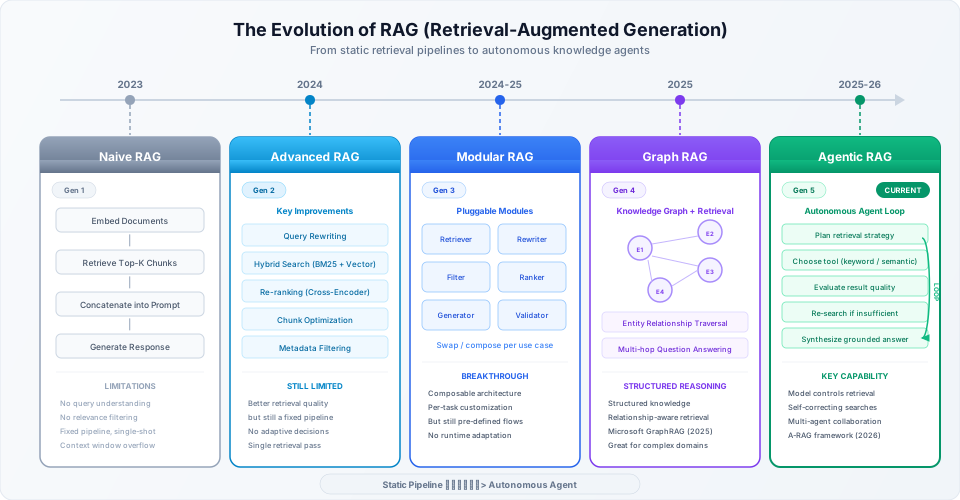
Retrieval-Augmented Generation has evolved through distinct generations, and understanding where we are helps make better architecture decisions.
The RAG Progression
-
Naive RAG (2023): Embed documents → retrieve top-k chunks → concatenate into prompt → generate. Simple but brittle — no query understanding, no relevance filtering.
-
Advanced RAG (2024): Added query rewriting, re-ranking, hybrid search (semantic + keyword), and chunk optimization. Better retrieval quality, still a fixed pipeline.
-
Modular RAG (2024-2025): Decomposed RAG into pluggable modules — retriever, rewriter, filter, generator — that can be composed differently per use case.
-
Graph RAG (2025): Integrated knowledge graphs for structured reasoning over entity relationships. Microsoft’s GraphRAG showed significant improvements on multi-hop questions.
-
Agentic RAG (2025-2026): The current frontier. Instead of a fixed retrieve-then-generate pipeline, an autonomous agent decides what to retrieve, when to retrieve it, and whether the results are good enough — looping until a grounded answer is achieved.
Agentic RAG in Practice
The key insight of Agentic RAG is giving the model control over retrieval decisions. A February 2026 paper (A-RAG) introduced hierarchical retrieval interfaces — three tools (keyword search, semantic search, chunk read) that the agent selects dynamically based on the query type.
This mirrors real human research behavior: you don’t search the same way for a specific API parameter vs. a conceptual explanation. Agentic RAG lets the model adopt the right retrieval strategy for each sub-question.
Enterprise Adoption
Microsoft now recommends starting new RAG implementations with agentic retrieval rather than traditional single-query patterns. For enterprise deployments, the critical additions in 2026 are:
- Access control integration — RAG systems that respect document-level permissions
- Audit trails — Which documents were retrieved, why, and how they influenced the output
- Multimodal retrieval — Searching across text, images, tables, and diagrams in a unified index
5. Edge AI and Small Language Models
Perhaps the most practically significant trend for 2026: AI is moving to the edge.
The SLM Revolution
Small Language Models (500M-10B parameters) can approach frontier model quality on focused, domain-specific tasks at significantly lower serving cost. The economic argument is compelling — self-hosted SLMs for targeted workloads can cost a fraction of equivalent frontier model API usage, though exact savings vary widely by use case.
Hardware Makes It Real
The hardware has caught up. In 2026:
- Apple A19 Pro: ~38 TOPS Neural Engine, runs 8B models at 20+ tokens/second (with GPU Neural Accelerators)
- Qualcomm Snapdragon X2: 80 TOPS, SLMs run locally on laptops without GPUs
- Intel Core Ultra 300: ~50 TOPS NPU (180 TOPS platform total), growing SLM support
A growing number of modern smartphones with NPU hardware can run local SLMs, and on-device inference is shipping in production apps.
Models Worth Knowing
| Model | Parameters | Best For |
|---|---|---|
| Microsoft Phi-3.5-Mini | 3.8B | Reasoning on CPU, approaches GPT-3.5 quality with far fewer parameters |
| Google Gemma 2 | 9B | Best quality-to-size ratio for cloud deployment |
| Mistral 7B | 7B | Most fine-tuning-friendly |
| Meta Llama 3.2 | 1B-3B | Mobile and edge deployment |
| Qwen 2.5 | 7B | Strongest multilingual support |
The Hybrid Architecture Pattern
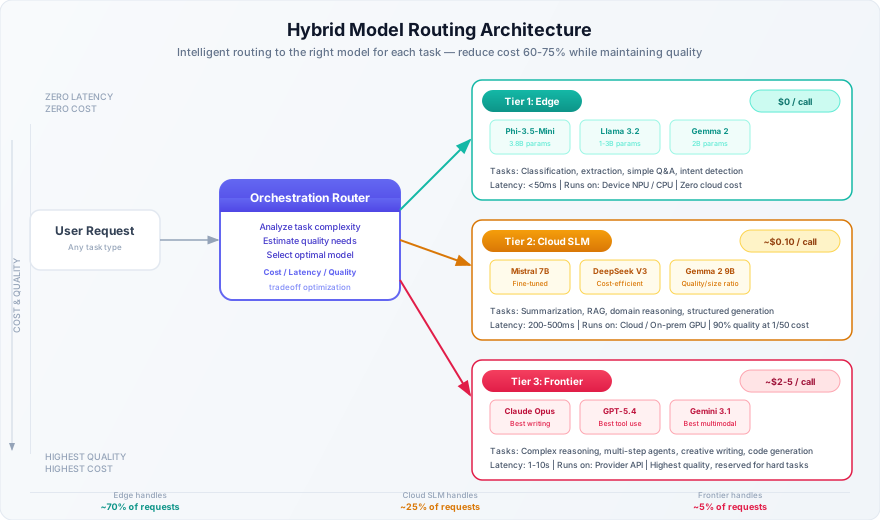
The winning pattern in 2026 isn’t “edge vs cloud” — it’s intelligent routing. A lightweight orchestration layer dynamically selects models based on the task:
- Simple classification / extraction → Local SLM (zero latency, zero cost)
- Domain-specific reasoning → Fine-tuned mid-size model (cloud or on-prem)
- Complex multi-step reasoning → Frontier model API (highest quality)
This pattern can significantly reduce costs compared to routing everything through a frontier model, while maintaining quality where it matters.
6. What This Means for AI Engineers
Skills to Invest In
- Multi-model orchestration — Building systems that route to the right model for each task, not just calling one API
- MCP server development — Writing tool servers that expose your systems to AI agents through a standard protocol
- Evaluation-driven development — You can’t improve what you can’t measure. Building systematic eval pipelines is now a core skill
- Retrieval engineering — Understanding when to use vector search, keyword search, graph traversal, or let an agent decide
- Quantization and edge deployment — Running models on constrained hardware with techniques like GGUF, AWQ, and SmoothQuant
Architecture Principles for 2026
- Don’t pick one model — Design for model-agnostic orchestration
- Start with eval — Define your success metrics before choosing infrastructure
- Embrace RAG before fine-tuning — RAG is cheaper, faster to iterate, and easier to debug
- Plan for MCP — Even if you start with function calling, structure your tools so they can be wrapped in MCP servers later
- Monitor relentlessly — LLM outputs are non-deterministic. Production systems need observability for latency, quality, cost, and hallucination rates
The Workforce Reality
Employment among junior software developers (22-25) has declined nearly 20% from the late 2022 peak (per Stanford Digital Economy Lab), even as senior headcount grows. Amazon announced 16,000 corporate layoffs, with AI-driven restructuring cited among multiple factors. The uncomfortable truth: AI is compressing the junior-to-senior pipeline. The engineers who thrive will be those who can architect, evaluate, and operate AI systems — not just use them.
Closing Thoughts
The spring 2026 AI landscape is simultaneously exciting and sobering. We have more capable models than ever, genuine agentic capabilities emerging, and a maturing infrastructure layer with MCP. But we also have legitimate bubble concerns, workforce disruption, and the environmental costs of rapidly escalating compute demands.
As AI engineers, our job is to cut through the hype and build systems that actually work. That means understanding the tools deeply — knowing when a low-cost open-source model is the right choice over a frontier API, when function calling beats MCP (and vice versa), and when an “agentic” system is just an overcomplicated pipeline.
The field is moving fast. The best strategy is to stay grounded in engineering fundamentals while continuously updating your mental model of what’s possible. I hope this post serves as a useful snapshot of where we are.
Sources and further reading:
- Stanford HAI — AI Index 2026 Report
- Microsoft — 7 AI Trends to Watch in 2026
- IBM — AI & Tech Trends 2026
- Forrester — Top 10 Emerging Technologies 2026
- MCP vs Function Calling — Descope
- Agentic RAG Survey — arXiv
- A-RAG: Scaling Agentic RAG — arXiv
- Dell — Edge AI Predictions 2026
- SLM Complete Guide 2026 — Calmops
- LLM Releases April 2026 — Fazm
- MIT Sloan — Five Trends in AI and Data Science 2026
- Agentic RAG Enterprise Guide 2026 — Data Nucleus