All Projects
Academic
Skin Lesion Segmentation with Improved U-Net
Deep learning model for melanoma detection achieving 0.8+ Dice score on the ISIC dataset, using an improved U-Net architecture.
Deep Learning TensorFlow PyTorch Computer Vision Medical Imaging
View Source
Overview
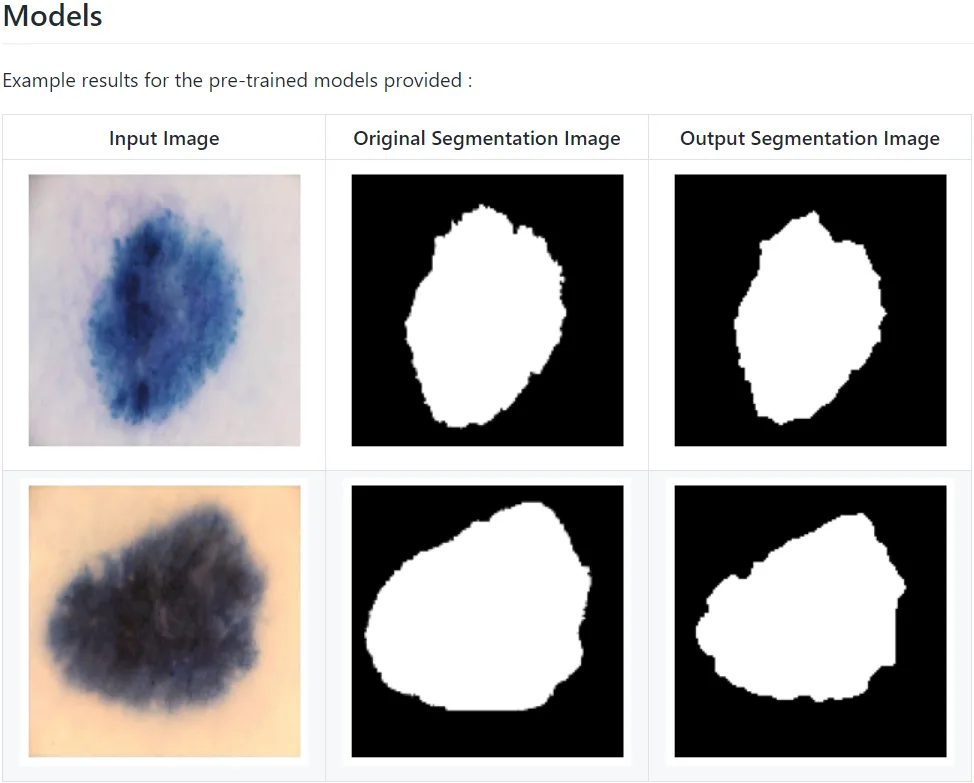
Applied an improved U-Net architecture to the ISIC (International Skin Imaging Collaboration) dataset for automated melanoma detection, achieving a minimum Dice score of 0.8 for lesion segmentation.
Approach
- Implemented improved U-Net with encoder-decoder architecture and skip connections for precise lesion boundary delineation
- Trained on the ISIC skin lesion dataset containing annotated skin patch images with binary segmentation masks
- Optimized with Dice loss function to handle class imbalance between lesion and non-lesion pixels
Key Learnings
- Pattern recognition via deep convolutional neural networks
- Practical experience with both TensorFlow and PyTorch frameworks
- Medical image preprocessing: normalization, augmentation, and handling of varied image dimensions
- Algorithmic design with software engineering principles for reproducible research